

ACP Clinical Guidelines, Population Health Policies, and Performance Measures
ACP develops clinical guidelines to provide you with recommendations based on the best available evidence, provide guidance when there is no evidence, and help you deliver the best health care possible. ACP has been developing clinical guidelines for nearly half a century and is the oldest clinical guidelines program in the United States.
ACP is internationally recognized for its scientific leadership and rigorous approach to developing trustworthy and transparent evidence-based clinical recommendations. ACP is the only U.S. organization to have earned designations as a GRADE (Grading of Recommendations Assessment, Development and Evaluation) Center and an AGREE (Appraisal of Guidelines for Research and Evaluation Center and is a founding member of the Cochrane US Network. ACP’s latest advancement was the publication of Incorporating Economic Evidence in Clinical Guidelines: A Framework From the Clinical Guidelines Committee of the American College of Physicians outlining methods for considering economic evidence in the development of clinical recommendations.
This year, ACP published the following papers:
- Pharmacologic Treatments with Lifestyle Modifications in Nonpregnant Adults with Overweight or Obesity in Outpatient Settings: A Living Clinical Guideline from the American College of Physicians
- Screening for Breast Cancer in Asymptomatic, Average-Risk Adult Females: A Guidance Statement From the American College of Physicians
Performance Measures
ACP works actively in the field of performance measurement because we recognize its importance in the changing health care environment and want to shape its impact on internal medicine. We understand that physicians question the value of performance measures and that performance measures represent an added burden to an already overworked and under-resourced physician workforce.
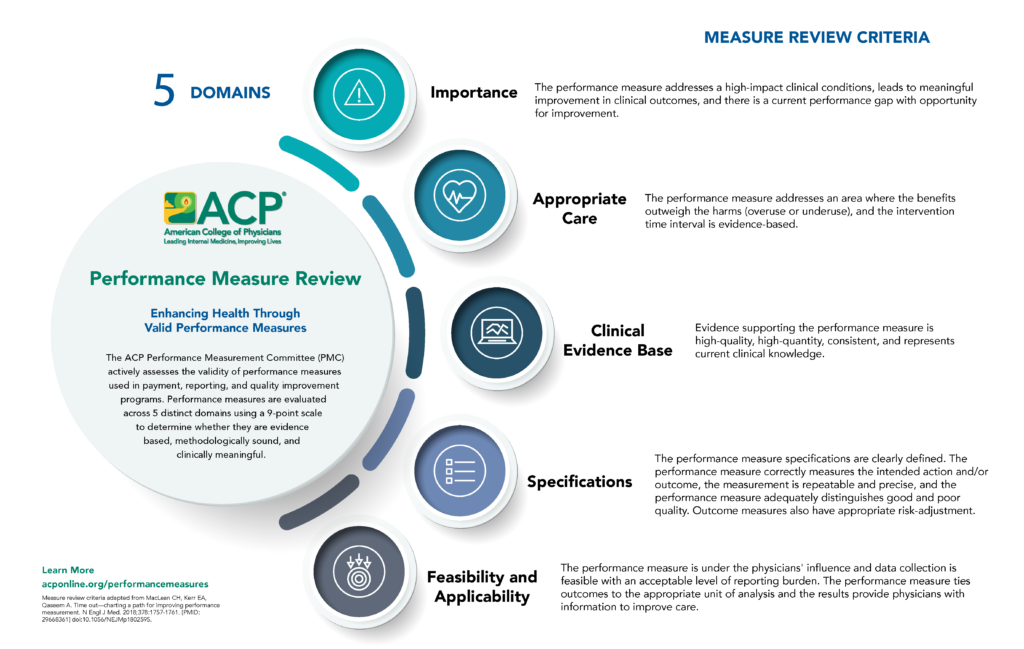
ACP conducts a thorough evaluation to review existing performance measures using five criteria: importance, appropriate care, evidence base, specifications, and feasibility/applicability. Based on these reviews, we strategically engage with payers and other important stakeholders in the measurement space to ensure that ACP-supported performance measures are included in value-based programs.
This year, ACP published Core Performance Measures for Migraine Headache, Quality Indicators for Screening and Surveillance of Colorectal Cancer in Adults, and Identifying Core Clinical Topics and Recommending Core Performance Measures for Internal Medicine Physicians.
Visit www.acponline.org/guidelines and www.acponline.org/clinical-information/performance-measures to learn more.
Annals of Internal Medicine
Annals of Internal Medicine consistently ranks as one of the world’s most widely read and highly cited peer-reviewed medical journals and earns more than a million page views each month at Annals.org. Annals publishes a wide variety of content in various formats, including original research, reviews, guidelines, and commentaries relevant to clinical practice, health care delivery, public health, health care policy, medical education, ethics, and research methodology. Articles published in Annals earn significant coverage in the general news media, with more than 21,000 mentions in 2025.
The Annals: Spotlight on 2025 collection highlighted must-read articles on aluminum-adsorbed vaccines and chronic diseases in children; measles, mumps, rubella immunization and the resurgence of measles in America; and step accumulation patterns and risk for cardiovascular events and mortality among suboptimally active adults.
Visit Annals to catch up on some of the most influential Annals articles published in 2025.

Annals published several high-impact articles concurrent with the Internal Medicine Meeting 2026, which were presented and discussed at the “New in Annals of Internal Medicine: Hear it First from the Authors.
The articles included:

Annals Special Features and Multimedia
Annals of Internal Medicine offers frequently updated multimedia features, including videos, graphics, and podcasts. Visit for a full description of each multimedia feature.
Last year, Annals launched the Annals Guide to Journal Club. Designed by Annals editors and editorial fellows, this resource helps journal club leaders guide discussions on core study design and statistical concepts. Each guide features key Annals articles, along with:
- Reading guides—Thought-provoking questions to spark discussion.
- Answer keys and slide presentations—Clear explanations of study design and statistical methods, and how they affect the interpretation of findings.
- Flexible presentation materials—Topics from the slide deck that can tailor your journal club discussions.
*Please note, this is separate from ACP Journal Club, also published by the American College of Physicians.
Annals of Internal Medicine: Clinical Cases
Annals of Internal Medicine: Clinical Cases (AIMCC), a bimonthly, open access journal published by ACP and the American Heart Association, features thought-provoking case reports designed to spark discussion and support clinical decision making. The journal welcomes a range of article types, including case reports, case series, and image and video cases.
Visit online to read published articles, submit a manuscript, or find information on how to become a peer reviewer.
Medical Ethics and Professionalism
ACP’s Center for Medical Ethics and Professionalism develops policies and case studies on timely issues for ACP members and the public. New ethics papers released this year include:
- Physicians Are Not Providers: The Ethical Significance of Names in Health Care
- Ethical Issues in Organ Transplantation
And a new ACP case study was released on:
- Updating the Information Blocking Rule: Implications for Patients and Physicians
- Substance Use Disorder & the Medical Record
The ACP Ethics Manual provides a solid foundation for our work, and our online ethics section offers more information.
DynaMedex®
DynaMed® continues its collaboration with ACP to provide members with free access to DynaMedex®—a powerful point-of-care tool that integrates expert clinical content from DynaMed with comprehensive drug information from Micromedex®. To help ensure content accuracy, ACP oversees the peer review of the Overview and Recommendations sections for the internal medicine topics most frequently used by ACP members. These peer-reviewed topics are marked with the ACP logo.
Featuring Dyna AI, an advanced generative AI search tool, DynaMedex delivers expert-curated, evidence-based answers within seconds. Sourced exclusively from DynaMedex content, Dyna AI provides trusted information—including study summaries, clinical guidelines, drug information, images, algorithms, and calculators—and expert commentary. (Note: Dyna AI can be turned off in user settings if preferred.)
Visit www.acponline.org/dynamedex to learn more about the benefits of DynaMedex.

ACP Journalwise
ACP JournalWise, an exclusive benefit of ACP membership, is a literature surveillance service developed in collaboration with McMaster University. Members can create personalized alerts on topics and specialties of interest drawn from 120 top-tier medical journals, review concise summaries, follow links to original abstracts, and share alerts with colleagues—all while browsing the tables of contents from leading medical journals. Access ACP JournalWise anytime, anywhere—from your desktop, tablet, or smartphone.

ACP Books
ACP offers a library of books that deliver practical, evidence-based guidance to support clinical practice and professional development.
Recently published titles include:
- Musculoskeletal Injections in Primary Care: A Practical Guide to Safe and Simple Techniques
A definitive visual field manual for the safe management of musculoskeletal pain. - Decision Making in Perioperative Medicine: Clinical Pearls, Second Edition
This updated edition focuses on the critical process of assessing and managing patients with medical comorbidities before undergoing surgical procedures. It includes new chapters on cardiac biomarkers, postoperative nausea and vomiting, and postoperative urinary retention. - Teaching and Coaching in the Hospital
The newest volume in the Teaching Medicine series provides guidance on fostering a culture of learning and improvement within the hospital setting.